By Arameh Etemadi: Gender in animation is one of the most debated topics in contemporary film studies. Due to the emergence of state-of-the-art technologies and their increasing dominance in families, techniques have found growing importance in animations and 3d films. Animated movies aren’t just for kids anymore. This aspect of animated movies and the concern for attracting a wider audience have become more important than ever before. Animations are being made with the approach to be interesting to people of all ages and viewers from all walks of life. Of course, there still exists a vast diversity in the field of animated movies, but the biggest productions of big companies, the films that get the chance of being screened in prestigious film festivals and events, and manage to attract the attention of film critics, are not solely made for children.
A Shifting Landscape
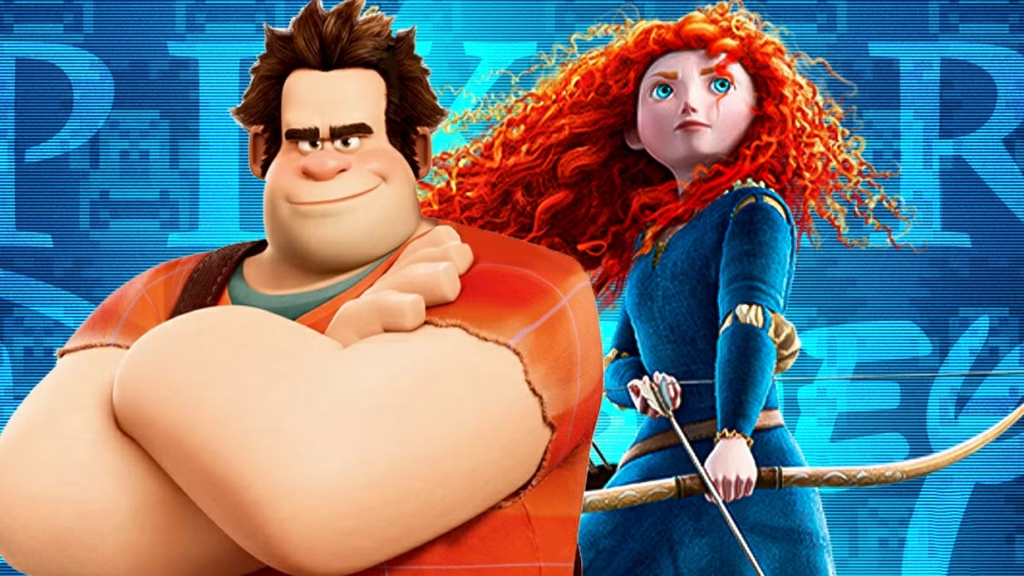
The subject of this article is the altering nature of animated movies. This shift in gender in animation reflects broader cultural changes in society and entertainment. This is why the study of gender in animation remains so relevant today. Looking at the films made in previous years, we may find out that animated features are in the process of changing their tone, their discourse, and especially their target audience. To narrate the fairy tales and sometimes realistic stories, the creators of these movies don’t appeal to the same usual definitions anymore. Their target audiences are no longer little girls fond of their Barbie dolls. In fact, the animation universe is tending towards more boyish, more masculine motifs and principles. This change of direction can be seen both in childish animations and the ones made with the approach of enticing the adult audience. This is true about the superhero movies based on comic strips and the animated features released in 2013, e.g., Wreck-It Ralph, Frankenweenie or the Academy Award-winning Brave.
In a time when public taste all around the world turns “Call of Duty” and “Battlefield” to best seller games and entertainment, the mainstream animations naturally incline to increasingly boyish moods as well. As a result of this basic transformation, the visual atmosphere, narrative themes, and the moral and psychological contents of these films have changed, too. The fantastic, imbued with colors and light world of the classic Disney and the girlish, tender tales of Cinderella, Snow White and the Seven Dwarfs, Sleeping Beauty, and The Little Mermaid almost don’t exist anymore. The dreamy female characters no longer appear as the protagonists of animated movies, and simple concerns like marrying a handsome, merry prince have been replaced with boyish themes or adult-friendly subject matters like the identity crisis (Rango), environmentalism (Lorax), the struggle to improve one’s character traits and social climbing (Wreck-It Ralph), etc.
The protagonist preferred by the majority of viewers is not the modest, secluded, and shy girl who cries for Cinderella’s afflictions and feels closer to the fulfillment of her dreams watching Cinderella’s happy wedding. Nowadays, animated movies are being made for restless boys who wish to reach puberty as soon as possible and thus not be taken for granted by their elders anymore. Boys who get excited by Shrek’s roaring as he tries to get rid of the intruders breaking into his lagoon. Boys who identify with Shrek and this green ogre’s demand to be left alone to do whatever he desires. After all, the greatest wish of these boys is to be able to do any dangerous, mischievous thing they like, even rolling in the mud, free from the obtrusive presence of their parents and the limiting social laws. Cinderella has been transforming into Shrek through a long, gradual metamorphosis, and now the beloved hero of the animations is of a different color and shape and behaving in a different manner.
Gender in Animation: The Case of Brave
Examining gender in animation through films like Brave reveals how deeply these changes have affected storytelling. The prominent cartoons of 2013 have been made by these new principles, following these new patterns. Brave is seemingly a girlish film because its protagonist is a cute curly-haired girl, but she couldn’t care less about girlish involvements and prefers the bow and arrow and fighting. Boyish concerns lie at the centre of the film, and the story is based on totally masculine principles. Even the title of the movie shows we’re not facing a film for girls.
The main character is a pampered princess with boyish habits. She rides a horse, climbs the mountain, drinks water from a cascade, and recklessly walks into the forest during the daytime or at night. Her sole point of attachment to the feminine world she represents is her relationship to her mother, who transforms into a bear, and now she is in need of the princess’s sacrifice to get free from the witch’s spell and to return to her original form.
If a prince were the protagonist of Brave, some Oedipal undertones would have been injected to the story, but the current characterization has turned the mother-daughter connection into a suitable vehicle for conveying some moral and educational themes regarding the family and family bonds. The thematic scope of the film is developed through the mother-daughter relationship, and some of the prevailing tensions and misunderstandings between parents and children are dealt with. Of course, at the end, the simple moral message, which is dearly favored by Disney and the system, illustrates the final purpose of Brave: “Girls should trust their mothers and do as they say.”
But what if mother had been replaced with father and the prince had been engaged in his adventures and in the war against enemies – a pattern resembling that of many animated movies? Something in the vein of How to Train Your Dragon, or rather Pinocchio, where the wooden puppet enters the whale’s belly to save father Geppetto. In this pattern, the differences between parents and children are mostly followed by a stage wherein the kid goes through an ordeal and finally repents.
The prevalence of boyish animation and the establishment of stories with power, the will to win, to measure one’s strength with someone and other macho values as their subject matters have replaced stories like Cinderella, Snow White and Sleeping Beauty with Spider-Man, Superman, The Lion King, Frankenweenie and Paranorman.
Disney vs. Pixar
The Disney-Pixar rivalry itself mirrors the ongoing conversation about gender in animation and who stories are truly made for. Wreck-It Ralph and Brave represent two different attitudes to narration. This probably comes from the view of Pixar and Disney, who, despite some similarities, have basic differences. Disney tends to a factitious and widely accepted approach to animation, following accepted formulas and patterns derived from the discourse of the American dream and well-known conservative concerns. But Pixar’s view can be considered as a Synthesis of pop culture and playful efforts of great cartoonists.
No one can ignore the importance of these two big companies, but it’s necessary to distinguish these two kinds of approaches from each other. Each one has its own taste, just like unlike taste of Spielberg and Tarantino. Just for some fun, we can resemble Disney as Spielberg or James Cameron, and on the opposite site Pixar can be figured as Tim Burton or Tarantino. Disney is stylish enough with its suit, but Pixar prefers casual with sport style.
The history of cinema gives numerous similar two-sided situations. One can compare John Ford and Sergio Leone in this regard. Ford puts his finger on some vital things like patriotism, men’s responsibility, and the main role of family in the basis of society, albeit with an apparent tendency toward male supremacy in the family. On the contrary, Leone reveals the dirty world of violence and incivility with no apparent intention to blame it. Spielberg ends his film with respect to the national flag and the war soldier’s grave, but Tarantino makes his natural killer hero the winner.
Right after Disney and Pixar merged, some worried about the probable impact of Disney’s rigid morality on Pixar’s innovative aspects. But the degradation of Pixar was simultaneous with the promotion of Disney. Now we can see lots of Disney touches on Brave, but surprisingly it is a Pixar production, whereas Wreck-It Ralph represents that innovative insouciance we used to trace in Pixar’s works.
Gender in Animation: Wreck-It Ralph
The contrast between Ralph and Vanellope perfectly illustrates the evolving dynamics of gender in animation. Brave seems to be a girly tale, but the inner layers of the story say something else. Wreck-It Ralph is a combination of girl and boy atmospheres. The boy’s features include over-activeness of the hero and his unstoppable desire to wreck everything, taking a gun and shooting. But when the story enters the world of pastry with such warm, vivid colors, we get some girly taste.
Vanellope in Wreck-It Ralph resembles the mermaid of Disney who lives in a shell. Similarly, Vanellope lives in a strange cave. As a mermaid knows the ocean well, Vanellope is familiar with its rubbish residence and even has fun with the flames. On the other hand, Ralph, who comes out of a video game, suffers from an identity crisis like most youngsters, though he doesn’t want to be a bad guy. He is jealous of Fix-It Felix because he can fix everything and everybody likes him: he is the star, the hero. Ralph’s obsession with his status, his hatred of his miserable life, his intense desire to win and be beloved — all of these reflect his efforts to find a better position in society, like most teenagers, especially boys at this age.
Characters like Ralph and Vanellope can be known as a reverse “The Beauty and the Beast”. Ralph may be considered “The Hunchback of Notre Dame”. The strange but passionate relationship between the ruiner giant and the lovely little girl is so interesting, like a similar relationship in The Princess and the Frog or the relationship between Sullivan, the horrible giant of Monsters, Inc., and a little girl from another world. We can even trace this eternal pattern in classic masterpieces such as Les Misérables and the relationship between Jean Valjean and Cosette.
Roots in Fairy Tales and Folk Literature
Most of these storytelling patterns are rooted in fairy tales and archaic fictions. We also can find them in medieval epopees, like the transformation of a pumpkin to a carriage, a wolf to a grandma, a mom to a bear, and a wizard to a beautiful lady. Later, the Grimm brothers used European folk literature (especially German tales) to create stunning fairy tales. In Northern Europe, Hans Christian Andersen developed this way, and his works turned to be a rich source of stories for cinema, from movies to animations, and still it is. In fact, the modern cinema that seems related to the contemporary arts is rooted in a distant past.
Certainly, all these animated movies, both films depicting a masculine world and the girlish ones, share some common ground. For example, Paranorman and Frankenweenie have some common undertones because both of them refer to cinema history and the Gothic and horror literature. Frankenweenie uses the templates of Mary Shelly’s Frankenstein, which has embodied the horror of giving birth to some monster or demon in the shape of the guilt rising from giving life to a sinister, frightening creature. In Frankenweenie, equivalents have been devised for these very same basic fears which find their suitable visual rendering in Tim Burton’s depressing, horrorful, and fantasy world.
The Body, Identity, and Animation
In Wreck-It Ralph, Ralph’s identity crisis also exists in his approach to the human body. The scene he wrecks everything after arriving at Felix’s party, followed by the splattering cake, is so familiar. We already know so many butterfingered characters in animations or movies whose bodies are out of their control so they can make a mess of everything unintentionally; like Dragon in Shrek, who innocently can’t avoid the fire jetting out of his mouth or crab in Mermaid or mother bear in Brave who can’t deal with his huge body that ruins everything at every single step.
This dramatic motive has been derived from one of the basic phobias in childhood, which is called Cacophobia — the fear of ugliness that might turn into a preoccupying thought. Most often, this phobia gradually fades away with the emergence of puberty, but can leave some emotional sequels, including deficient self-confidence. Most of the animated characters reflect this challenge between the mind and the body. Dragon, crab, mother bear, Ralph, and Pinocchio (when he changes to a donkey) are afraid of being unintended wreck-its. They can help little viewers to come along with reality.
This metamorphosis teaches the children that they must be patient if they want to be born like a butterfly that pierces the cocoon, or it takes time to be a beautiful white swan from the ugly duckling. Hey Kids! Don’t worry. The salvation is there. We all will get rid of these ugly bodies someday. Ultimately, gender in animation continues to shape how children and adults understand identity and society.