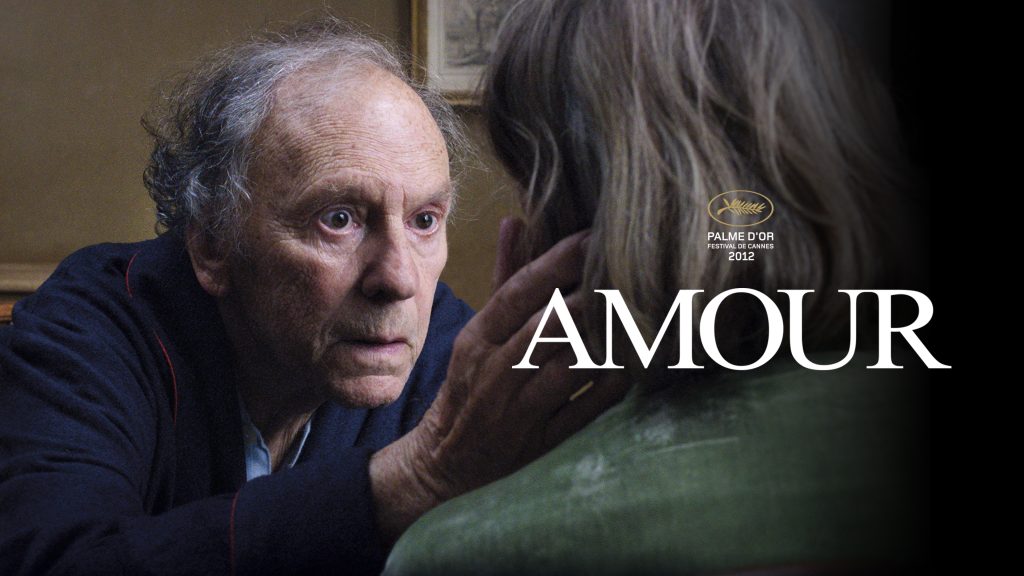
Haneke’s movies haven’t been made with the intention to delight or even
amuse the audience. They are mostly bitter concise interpretations of
human suffering, made with the sole purpose to plant a seed in the mind of the
audience and to raise an idea which may serve as the starting point of a long
route. From this angle, watching a film by Haneke should be accompanied by
a required willingness to experience pain and philosophical and moral
seriousness. This is especially true about his Amour: A cold slow film featuring
aged and frail characters that can barely walk within a narrow limited space
and rusty setting, surrounded by a sorrowful aura of senility, sickness and
reaching the end. However, after hearing the title of the movie and then
looking at its grey poster, you may hope to witness a mythical, even though
despairing, love which unlike Haneke’s other films, may not be totally imbued
with depression..
Amour enjoys an existential theme which, at its core regards humans as a
source of free will and creative authority, notwithstanding the limitations arising
from their physical frame and natural temper. According to this
worldview, humans shape and make themselves by their own decisions and
experiences and by the way, they are responsible for their choices, obliged to build
their own destiny based on their own criteria (and not the established general
patterns). Like any other human being, Georges and Anne have been
condemned to live each of their moments choosing between available options
and now in a decisive (final?!) turn of their being, they have to yield to a
critical (unavoidable?) decision. According to Haneke’s Existentialist way of
thinking in Amour, Determinism is basically impossible. Humanity can’t help
being free (and this is not caused by humanity’s impotence but the
impossibility of the matter). In certain situations, the range or diversity of the
options may be reduced and humanity’s freedom may be submitted to further
bonds but after all, human beings have free will. In a frightening but natural
and even ordinary moment, Georges and Anne are forced to make a decision.
And instead of resorting to a hospital or a sanitarium, they decide upon the
serenity of a neat liberating death beside each other. Although it is Anne who
is facing death, Georges has a share in it as well. Their lives, emotions, habits
and rather their “being” is merged into each other in a way which makes it
barely possible to put a finger on one of them as the decision maker. Anne freely
chooses death as some kind of deliverance to put the full stop on her
misfortune. She doesn’t want to live anymore. She doesn’t want to surrender
to the anguish and pain of her last moments and she wants to spare Georges
this pain as well.
Georges has an equal share in the final decision. He reviews the
memories of the past (which unlike many similar stories are not from a distant
past); He remembers a beautiful and healthy Anne playing piano, but in the
meantime, he is aware that every moment brings them closer to the end.
Amour inevitably recalls that peerless eternal soliloquy “To be, or not to be”.
Hamlet had to go through a philosophical/moral ordeal and his affliction
shaped Shakespeare’s drama, but Haneke’s characters don’t follow a
philosophical or moral purpose in their decisions. They don’t “create” death as
an inevitable truth and an existing conception. They just conjure it and push
forward its time. Here, unlike a lot of great dramas and tragedies of the
classical literature, it is not pretended as if a choice between life and death is
being made and instead, Georges and Anne regard death as a natural ending.
Love’s drama is born out of the conflict between pain and relief. The elderly
couple’s choice is relief. They apply to death as a means to reach relief and
to put an end to the misery and contempt and to avoid further distress. But
does Geroges really stand in the same place as Anne? Does dedicating a
releasing death to his wife lead him to something but pain?
The conditions of the two protagonists of Amour in the last chapter of
the story strongly reminds us of the concept of Yin and Yang in the philosophy
of Taoism and the presence of two opposing but complementary principles
within all the beings and phenomena. In a way, Anne and Georges are Yin and
Yang: One of them relieves pain and the other provides relief from pain
reaches. One can observe some hints at Buddhist thought in Amour, among
Haneke’s non-religious, devoid of Metaphysics attitude towards the
definition of the concept of death and the aforementioned existential aspects of
this attitude.
One of the fundamental, well-known principles of Existential philosophy is
that to decide and to know oneself, humans need to go through decisive
turning points or critical particular situations which have been subtly classified
into four estates and forms: the near-death experiences, frustration,
turbulence and guilt. However, there is also a fifth estate which from time to
time is placed next to the other four: love. In each of his films Haneke passes
through these four situations and each of these notions and feelings is
somehow involved in giving form to the fatalistic facets of the story and in
determining the destiny of the characters. Indeed the plot’s climax is a result
of the worsening of Anne’s conditions and her getting closer to death. Then
despair and anxiety which play a crucial role in the development of events of
the story, gradually become sensible in the manner of Georges and Anne and
their daughter. And finally, Georges and Anne’s decision leads to feelings of
guilt. And Georges shall carry the burden, while Anne has finally found
redemption. And about the fifth notion, it is too obvious to require explanation.
Amour owns the capacity to easily lead the audience to nihilism and
towards a feeling of futility about everything he or she has been watching:
George’s and Anne’s life together comes to an end, Anne is dead, George is left
behind with a load of unpleasant feelings and death is the end of everything. A
life lovingly built by two people is definitely over, leaving only memories and
daydreams. Hereby, Haneke shows us that every love, fulfilled or not, will end
with death, even if we try to keep it alive. The portrayal of Anne’s death partly
recalls the act of releasing a hopelessly sick or injured animal by killing it. After
all, it is death that embitters anything and reduces everything to nothing.
Without Anne, Georges is nothing, impartial. That is why he leaves house after
releasing Anne by killing her. From this stance, Haneke could have been
influenced by Kafka’s stories and thoughts. He has combined Existentialism
with Nihilism, although without a trace of Kafka’s absurdist motifs on love.
In addition to the disagreeable impression left by Amour in the mind of
the audience which is due to the subject matter and the claustrophobic
atmosphere of the film, its slow pace and lingering halts on people, objects and
the milieu of the house could be among the factors that make Amour
unwatchable for some people. Deeds like making love and killing a human
being have been pictured with utmost simplicity and seriousness by Haneke
and this is exactly what makes the film menacing and devastating. Haneke
doesn’t manipulate reality and instead of amusing and delighting his audience,
he insists on making them suffer and think. Of course those viewers who are
familiar with this filmmaker and his extraordinary approach, prepare
themselves in advance for watching a distressful masterpiece, ruthlessly
presenting the acrid bare reality. However, the difference between the
shattering impression of Amour and the unsettling effect of Haneke’s previous
films is as much as the difference between The White Ribbon and the
“controlled” violence of Amour. A difference of the same kind we may find
between a silent murderer with ordinary looks and manners and an angry
raging killer with a gun in his hands. There’s no need to say that getting face
to face with which one of these two murderers could be more frightening and
disturbing.
The slow sluggish pacing of the film is reasonably in perfect agreement
with the atmosphere and characters. Georges and Anne are an elderly couple
with a limited quiet life whose every moment is spent in a house which is in
fact their individual world and area. In accordance with this, the atmosphere of
the film is also attuned to this house and the bland empty lives of its
inhabitants. In coordination with Georges’ limping and shuffling around the
house, the film also breathlessly drags itself forward and like its protagonists
pause from time to time to be drowned in a boring silence. But these quiet
interludes have been included deliberately and each moment of them is in total
control of the director. As the film moves forward, this rhythm becomes
increasingly faster (and not faster) and comparing the different parts of the film
demonstrates Haneke’s meticulous timing and his deliberate detailed work on
each of the shots and the consistent whole. A precision which has been equally
applied to the arrangement of the house’s furniture and complements the
characters’ development. Dariush Khonji’s camerawork, characterized by the
slow movements of the camera shooting from the best angles is surely one of
the most effective elements of the film which manages to entice the viewer to
keep on watching a story as slow and sad as this which also takes place in a
single location.